

$ 0ttl resilience check |

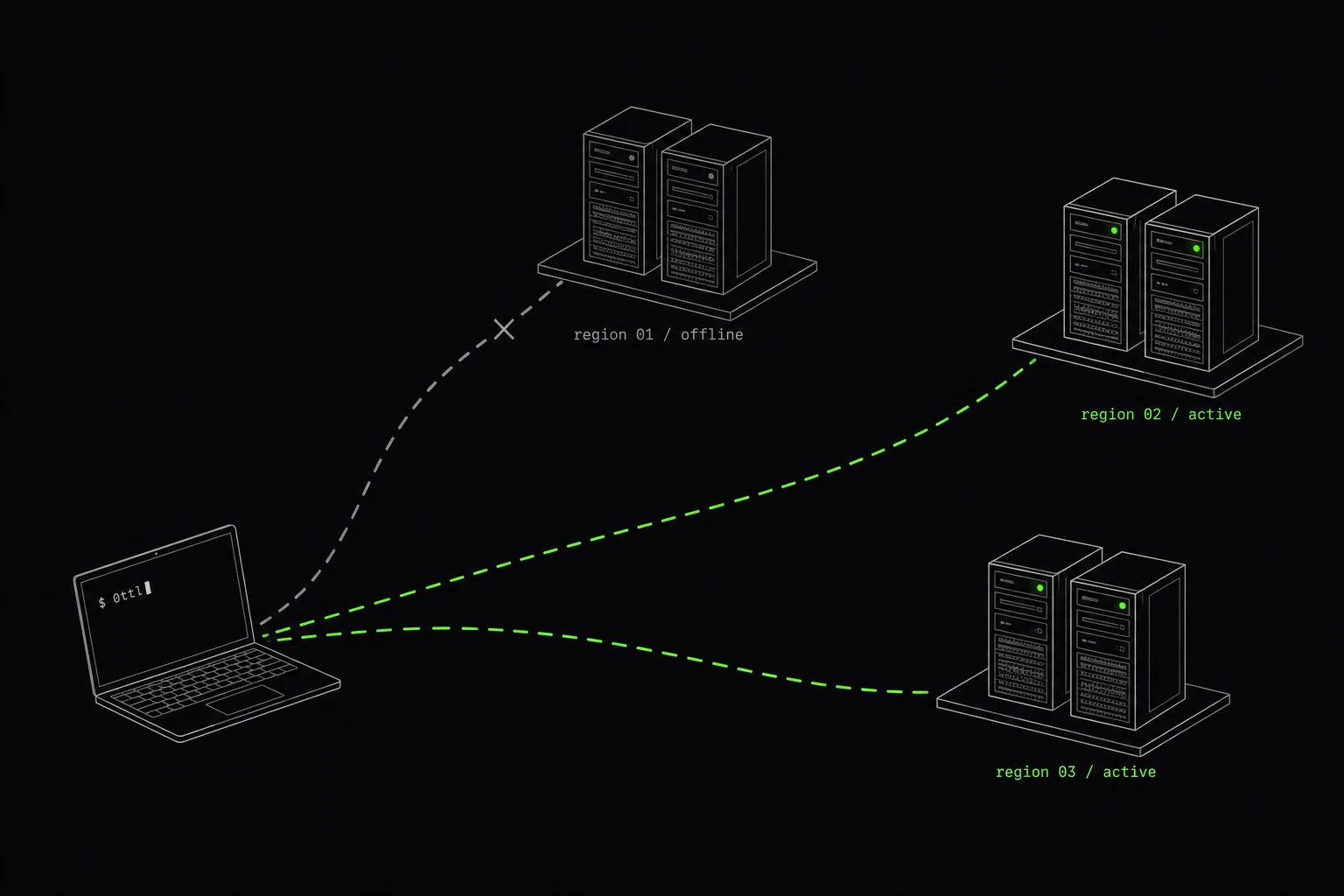
Prove your multi-region Kubernetes failover before an incident does.

0TTL helps teams validate Kubernetes-native DNS/GSLB resilience before a customer-facing outage proves the gap. From the creators of k8gb.

Global resilience without global lock-in.

$ cat ./why-0ttl.txt |

  • ✓ Failure-path validation

    Most teams have a failover design. Fewer can prove customer-facing traffic behavior across Kubernetes, DNS/GSLB, health signals, and operational runbooks.

  • ✓ Kubernetes-native global resilience

    0TTL builds on deep k8gb and cloud-native experience to help teams reason about global traffic behavior without turning global availability into a proprietary platform dependency.

  • ✓ DNS and ownership clarity

    Product-level global availability spans DNS, networking, platform, security, and application readiness. 0TTL makes those assumptions explicit.

  • ✓ Production-ready evidence

    0TTL turns architecture diagrams and YAML into risk reports, failover test plans, executive summaries, and production blueprints that product, security, revenue, and platform teams can use.

$ cat ./who-this-is-for.txt |

For Teams Turning Availability Into Product Value

Global availability is not only an infrastructure project. For SaaS and Fintech teams, it affects enterprise deals, regulated markets, product roadmap, and customer trust.

  • target.role / product

    Product Leaders

    Region expansion, data residency, and global availability become product capabilities. 0TTL helps evaluate Kubernetes-native DNS/GSLB designs before they become roadmap commitments.

  • target.role / security

    Security & Compliance Leaders

    Availability commitments need evidence. 0TTL documents DNS/GSLB assumptions, failure paths, continuity runbooks, and validation results in a form reviewers can use.

  • target.role / revenue

    Revenue Leaders

    Enterprise customers ask about uptime, regional availability, and recovery proof. 0TTL helps turn technical resilience posture into credible customer-facing evidence.

$ cat ./services.txt |

  • $ 0ttl resilience check

    Resilience Check

    A lightweight assessment for teams evaluating product-level global availability, region expansion, or customer-facing resilience commitments.

  • $ 0ttl resilience report --format pdf

    Automated Resilience Report

    Generate a structured risk report from topology inputs, Kubernetes manifests, DNS/GSLB assumptions, availability commitments, and operational constraints.

  • $ 0ttl resilience review --expert

    Expert Resilience Review

    A focused senior review when product commitments, data residency requirements, or enterprise customer questions need architectural judgment.

  • $ 0ttl resilience validate --scenario regional-failure

    Failure-Path Validation

    A practical validation plan for regional failures, stale DNS records, ownership conflicts, health signal gaps, and split-brain scenarios before multi-region behavior is sold or relied on.

  • $ 0ttl blueprint generate --production

    Verified Production Blueprint

    A product-readiness package covering topology, runbooks, monitoring, alerting, upgrade safety, DNS/GSLB assumptions, and operational responsibilities.

  • $ 0ttl support enable --lts

    Enterprise LTS & Support

    Long-term support for teams adopting or running k8gb-based global resilience, including upgrade guidance, compatibility review, report refreshes, and operational support.

$ cat ./maturity-model.txt |

Global Resilience Maturity Model

0TTL helps teams move from "we have a design" to "we know how product traffic behaves under failure."

  • Level 0: Regional only

    No real global failover strategy.

  • Level 1: Designed

    Architecture exists, but behavior is not proven.

  • Level 2: Configured

    Kubernetes and DNS/GSLB components are in place.

  • Level 3: Observable

    Health signals, DNS state, and routing behavior are visible.

  • Level 4: Validated

    Failure paths have been tested end to end.

  • Level 5: Guaranteed

    Validation, support, runbooks, and operational evidence are maintained continuously.

$ cat ./about.txt |

0/ttl focuses on global resilience for Kubernetes-based products and platforms.

We help SaaS, Fintech, multi-cluster, hybrid, and regulated teams understand how their global traffic layer behaves before customers depend on it.

Our team includes original creators of k8gb, the CNCF project for Kubernetes-native GSLB. Our work is rooted in DNS-based global traffic management and real-world platform engineering experience.

We do not replace your platform team. We help make failure behavior explicit, testable, and explainable.

  • ✓ Failure behavior clarity

    Make failover assumptions explicit, testable, and explainable

  • ✓ k8gb creator expertise

    Guidance from engineers who helped create Kubernetes-native GSLB

  • ✓ DNS and GSLB review

    Validate ownership, TTLs, health signals, and routing behavior

  • ✓ Evidence for stakeholders

    Turn technical state into reports, runbooks, and validation plans

$ cat ./operating-principles.txt |

Operating Principles

The services are outputs. These are the constraints we use to keep resilience work useful in production.

  • principle.01 / behavior

    Prove Behavior, Not Intent

    A design is not enough. Resilience work should show how the traffic path behaves when DNS, health signals, regions, or handoffs fail.

  • principle.02 / ownership

    Make Ownership Visible

    DNS, GSLB, networking, platform, and application readiness often sit with different teams. Boundary conditions need names, owners, and escalation paths.

  • principle.03 / traffic-layer

    Keep the Traffic Layer Inspectable

    Prefer architectures operators can inspect, reason about, and recover without depending on opaque or proprietary global lock-in.

  • principle.04 / constraints

    Validate Real Constraints

    Tests should account for TTLs, DNS propagation, health signal timing, rollout windows, access controls, and change-management limits.

  • principle.05 / evidence

    Create Evidence People Can Use

    Reports and blueprints should help SREs, platform leads, product owners, security reviewers, and revenue leaders make the same decision from the same facts.

  • principle.06 / lifecycle

    Treat Resilience as a Lifecycle

    Clusters, DNS records, application readiness, and team ownership change. Validation evidence should be maintained, not filed away once.

$ 0ttl contact start |

Ready to validate your failure path?

If global availability is becoming a product feature, enterprise commitment, or regulated-market requirement, 0TTL can help you understand whether the traffic path is designed, configured, observable, or actually validated.

$ 0ttl offerings list

  • ✓ Free initial resilience discussion
  • ✓ Automated resilience report
  • ✓ Expert topology review
  • ✓ Failure-path validation plan
  • ✓ Verified production blueprint
  • ✓ Enterprise LTS and support